
You’ve probably noticed it before a big outing, a crowded church service, or just an ordinary Tuesday morning. Your child stiffens. Their body goes on high alert before anything has even happened. Sounds feel too loud, transitions feel like emergencies, and the nervous system just won’t settle — no matter what you try.
That pattern has a name, and it has a solution. The Safe and Sound Protocol is one of the tools we use at Sense Able Brain to help children shift out of that constant state of threat and into a place where they can actually learn, connect, and grow.
If you’ve been searching for answers — and maybe trying things that haven’t quite worked — this post is for you. Here’s what you need to know about the Safe and Sound Protocol for kids, how it works, and whether it might be the missing piece for your child.

What Is the Safe and Sound Protocol?
The Safe and Sound Protocol (SSP) is an audio-based intervention developed by Dr. Stephen Porges, the neuroscientist behind Polyvagal Theory. It uses specifically filtered music to train the nervous system to feel safe. The music is processed to emphasize the frequency range of the human voice, which signals to the brainstem that the environment is calm and connection is possible.
Polyvagal Theory proposes that the human nervous system is always scanning for safety or danger through a process called neuroception — and that this scanning happens below the level of conscious awareness. When a child’s nervous system is chronically reading the environment as unsafe, behavioral and emotional challenges follow. The SSP works directly at that level, not through talking or thinking, but through the auditory system’s direct link to the vagus nerve.
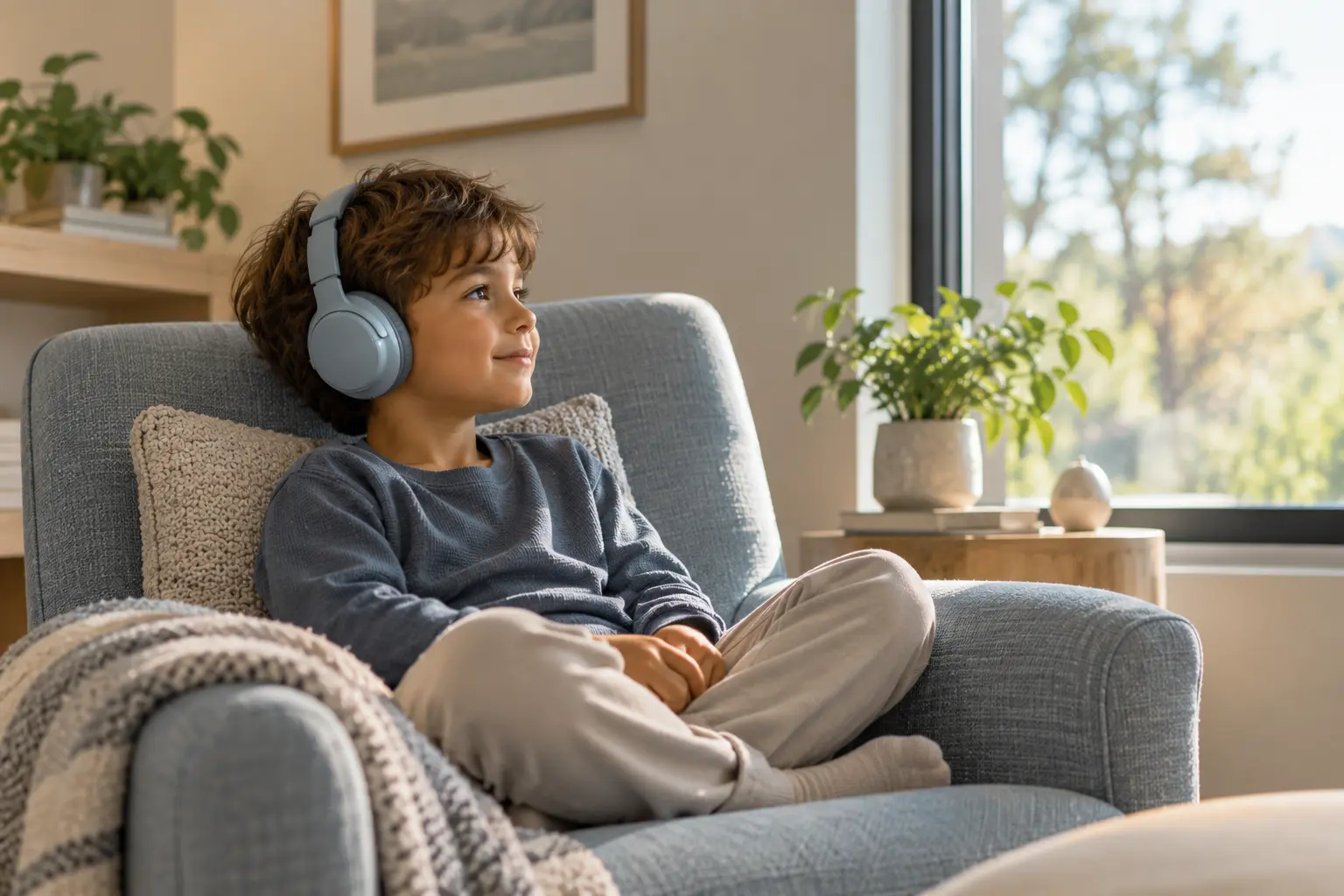
The protocol itself is non-invasive. Your child listens to about five hours of specially filtered music through headphones, typically across multiple shorter sessions. There’s no demand, no performance, no right or wrong answer. They can draw, play quietly, or just rest. The nervous system does the work.
How the Nervous System and Sound Are Connected
This part matters for understanding why the SSP works, and why it works specifically for the kids who need it most.
The middle ear muscles — the same ones that tune our hearing toward human speech frequencies — are directly connected to the vagus nerve. The vagus nerve is the body’s main communication highway between the brain and the organs. When those middle ear muscles are toned and regulated, the vagus nerve signals safety. When they’re dysregulated, even ordinary sounds can feel threatening, social cues become harder to read, and the body stays in a state of chronic low-level stress.
Many children with sensory processing challenges, autism, anxiety, ADHD, or developmental delays have an auditory system that is stuck filtering the environment for danger. The SSP gently exercises those middle ear muscles through the filtered music, helping the nervous system begin to detect safety more reliably. Over time, that shift shows up in behavior, regulation, communication, and connection.
For a deeper look at how sound and the nervous system intersect in developing children, the NIDA research overview on neurodevelopmental pathways offers useful context on why early nervous system patterns matter so much for long-term development.

Which Children Tend to Benefit Most from the Safe and Sound Protocol?
The safe and sound protocol for kids tends to be most effective for children who are already stuck in patterns of fight, flight, or freeze. If your child melts down over sounds, textures, or unexpected changes, the SSP addresses the “why” behind those reactions.
Children who often respond well include those with:
- Sensory processing disorder or sensory sensitivities to sound, touch, or environment
- Anxiety, including social anxiety and separation anxiety
- Autism spectrum disorder, especially where social engagement and language are affected
- ADHD with emotional dysregulation
- Trauma histories or pediatric PTSD
- Feeding challenges rooted in sensory aversion
- Language delays, including Gestalt Language Processing
That said, the SSP is not a standalone fix for any of these challenges. It works best when it is woven into a broader therapy program. At Sense Able Brain, we layer the SSP within our Sound Learning Therapy framework, which means it’s delivered alongside occupational therapy or speech therapy, not in isolation. That matters because the nervous system changes opened up by the SSP need to be supported and built upon with skill-based work.
Can You Do the Safe and Sound Protocol at Home?
This is one of the most common questions parents ask, and it makes sense. Parents want to help their kids and want to start now.
The SSP is available through trained providers only, and that’s not gatekeeping — it’s safety. For children with significant nervous system dysregulation, the protocol can bring up intense emotional responses as old patterns begin to shift. A trained therapist monitors your child’s responses session by session and adjusts the pacing as needed. They also know when to pause, when to support, and when to layer in other regulatory activities.
The American Occupational Therapy Association recognizes the importance of trained clinical decision-making when introducing sensory-based interventions, and SSP delivery is no different. Going it alone without clinical support increases the risk of the protocol feeling overwhelming rather than regulating.
Our practice offers the SSP administered by our OTs and SLPs, with sessions paced based on your child’s tolerance and your family’s goals. We also make sure parents understand what to expect during and after sessions, because the days following SSP delivery can sometimes bring temporary emotional releases as the nervous system recalibrates.

What to Expect When Your Child Does the Safe and Sound Protocol at Sense Able Brain
When a child receives the SSP at our clinic in Lutz, FL, it doesn’t happen in a clinical vacuum. We integrate it into sessions that already include the sensory, motor, or communication work your child needs. The SSP functions as an activating agent — it opens a window of receptivity in the nervous system so that the other therapy work lands more deeply and lasts longer.
This is core to our A.B.L.E. program philosophy: Activate, Balance, Link, and Engage. The SSP falls in that “Activate” phase, helping the nervous system shift into a more regulated state so that the balancing and linking work that follows can take hold. Parents sometimes describe seeing changes within the first week of the protocol — better sleep, more eye contact, calmer mornings, a child who seems more available for connection.
We also offer free wellness services for parents while their child is in therapy. You matter in this process. A regulated parent is one of the most powerful co-regulating forces a child has, and we want to make sure you’re supported too. If you’re wondering what else we offer alongside the SSP, visit our services overview to see how everything fits together.
Is This the Right Time to Try It?
Here’s the clinical reality: the nervous system is most plastic when intervention starts early, but it is never too late. Our team has seen meaningful shifts in school-age children, teens, and adults who had been stuck for years in patterns of dysregulation.
If your child’s body is in a constant state of alert, making it hard to learn, connect, or simply get through the day without falling apart, the SSP is worth a serious conversation. It’s not a miracle, and outcomes can’t be guaranteed. But for many families, it has been the intervention that helped everything else finally work.
You can read what other families have experienced on our testimonials page, and if you’d like to see what parents in the Tampa Bay area are saying about working with our team, read our client reviews on Google to hear their stories in their own words.
Ready to find out if the safe and sound protocol for kids is the right fit? Request an appointment or reach us by phone at 813-803-3470. We’d love to talk through what your child is experiencing and whether SSP belongs in their plan.
Reviewed by Kim Hazelton, OTR/L
Kim Hazelton is a pediatric occupational therapist with over 30 years of experience. She offers expert, whole-person pediatric therapy for children facing sensory, speech, feeding, and developmental challenges. Her neurodevelopmental approach addresses the root cause of these struggles, helping your child build lasting skills and succeed in every milestone, at home and in school.