

You’ve probably tried a lot of things. Sensory diets, weighted blankets, therapy brushing protocols, maybe even a different school environment. And still your child melts down, shuts down, or can’t quite get regulated the way you hoped. If that sounds familiar, you may have started hearing about laser therapy for children with sensory issues, and wondering if it’s worth a closer look.
The short answer is yes, it’s worth understanding. The longer answer is that it’s not the sci-fi treatment the name might suggest. It’s a gentle, non-invasive approach grounded in decades of research on how light affects the nervous system. And when it’s paired with occupational therapy inside a thoughtful neurodevelopmental framework, it can support changes that go deeper than behavioral strategies alone.
Here at Sense Able Brain, we use the Quantum Reflex Integration (QRI) laser inside our A.B.L.E. program, and we also offer it on its own. Before a family ever books an appointment, they usually have a lot of questions. This post answers the most important ones.

What Laser Therapy for Sensory Issues Actually Does
The technical term for this approach is photobiomodulation, or low-level laser therapy (LLLT). A low-level laser delivers specific wavelengths of light into tissue without generating heat and without cutting or damaging anything. The light energy penetrates the skin and stimulates cellular activity, particularly in the mitochondria, the energy-producing structures inside every cell.
For children with sensory processing challenges, the relevance comes down to the nervous system. Sensory processing difficulties often involve dysregulated neural pathways, retained primitive reflexes, and a nervous system that struggles to shift between states of calm alertness and activation. Research published in NCBI’s PubMed database shows that low-level laser therapy can influence neurological function by promoting circulation, reducing inflammation at the cellular level, and stimulating the repair and organization of nervous tissue.
What this means practically is that the laser can help the brain and body communicate more effectively. A child whose nervous system is stuck in a fight-or-flight state has a harder time learning, regulating emotions, or tolerating sensory input. Photobiomodulation supports the conditions where that regulation becomes possible.
What the QRI Laser Is and Why We Use It Specifically
Not all laser therapy devices are the same, and that distinction matters when you’re talking about children. The Quantum Reflex Integration (QRI) laser is a cold laser specifically used in the context of reflex integration and neurodevelopmental therapy. It operates at wavelengths that target the nervous system rather than tissue repair alone, and it’s used by occupational therapists and speech-language pathologists trained in its protocols.
At Sense Able Brain, the QRI laser is applied at specific points along the body that correspond to primitive reflexes. Primitive reflexes are automatic movement patterns that develop in utero and should integrate during the first year or two of life. When they don’t, retained reflexes can create a cascade of challenges including poor postural control, emotional dysregulation, difficulty with fine motor tasks, sensory defensiveness, and even speech and language delays. You can read more about this on our page about primitive reflexes.
The QRI laser supports the integration of these retained reflexes by stimulating the neural pathways involved, reducing the “noise” in the nervous system, and creating conditions where movement-based reflex integration work can take hold more effectively. It doesn’t replace the therapy, it accelerates it.
Which Children Tend to Benefit Most
Laser therapy for sensory issues is not a one-size-fits-all tool, but certain children respond particularly well to it. Based on what we see in our clinic, these are the kids who tend to show the most meaningful progress when QRI laser is included as part of their program:
- Children with sensory processing disorder who remain dysregulated despite traditional OT intervention
- Children with retained primitive reflexes driving behavioral or academic challenges
- Children diagnosed with autism spectrum disorder who have significant sensory sensitivities
- Children with ADD or ADHD whose attention and regulation difficulties seem rooted in a nervous system that never settled
- Children who struggle with anxiety that appears physically, as avoidance, meltdowns, or extreme startle responses
- Children with feeding challenges connected to oral motor or sensory aversions
The National Institutes of Health has documented growing evidence for photobiomodulation’s role in neurological conditions, and the body of peer-reviewed research specifically on autism and sensory-related applications continues to grow. We stay current on this literature and apply it through the lens of what we actually see in each child’s presentation, not a protocol applied the same way to every child.
What a Session Looks Like (and Why Kids Tolerate It So Well)
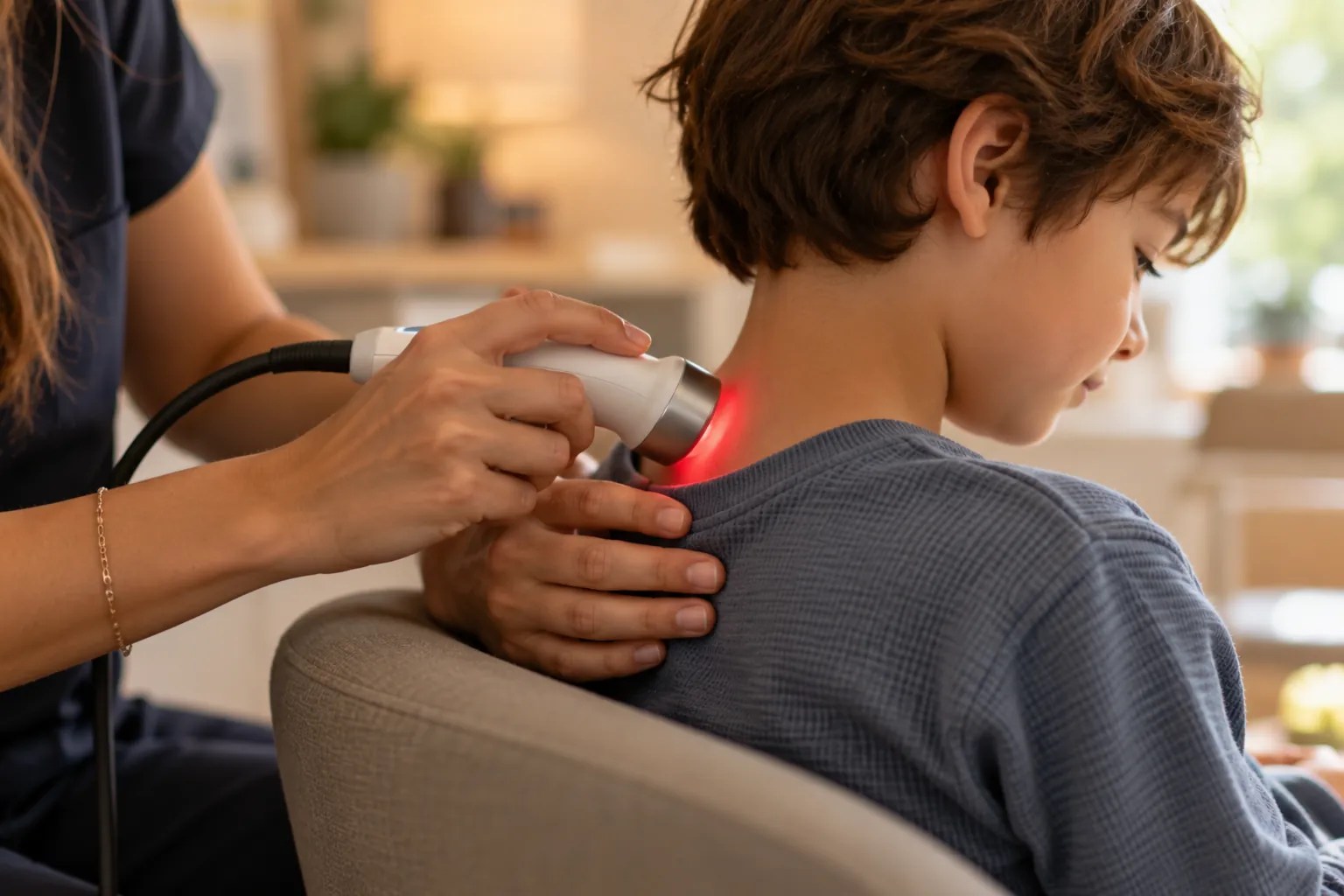
One of the most common concerns parents raise is whether their already sensory-sensitive child will tolerate a laser device near their body. The answer, almost universally, is yes. The QRI laser produces no heat and no sensation that most children can perceive. It can make a soft sound, but that is optional and can be switched off for children who would rather have quiet. There’s nothing to fear and nothing to push through.
A session typically involves the therapist applying the laser handpiece gently to specific reflex points while the child sits, lies down, or even plays. Younger children often don’t realize anything is happening at all. The treatment is administered by our licensed OTs or SLPs, always within a session that includes hands-on reflex integration work and other sensory-motor activities. Within therapy sessions, the laser is a tool inside a broader clinical framework.
Parents often notice that children seem calmer or more focused in the hours following a session. Over a series of sessions, families commonly report improvements in emotional regulation, sleep, tolerance of sensory input, and the ability to engage with other therapy activities. We pair the QRI laser with our Sound Learning Therapy when appropriate, since both work to regulate the nervous system from different access points.

How Laser Therapy Fits Inside Our Bigger Picture
One thing that genuinely separates what we do from a conventional clinic is that we don’t treat symptoms in isolation. Every tool we use, including the QRI laser, exists inside our A.B.L.E. framework: Activate, Balance, Link, and Engage. The goal is not just calmer behavior in the therapy room. It’s a child who can succeed at home, at church, in their homeschool environment, and eventually out in the world.
For the families we work with, especially moms who have tried everything and still don’t have answers, the QRI laser often becomes one piece of a puzzle that finally starts to make sense together. We also pair neurodevelopmental work with the Safe and Sound Protocol and bodywork when indicated, because the nervous system responds to multiple inputs and sometimes one pathway unlocks what another couldn’t. You can explore the full range of what we do on our services page.
The laser does not have to be part of a larger plan to be worth doing. Some families come to us specifically for QRI laser work, so we offer it as a standalone treatment as well as within our sessions. If your child is already working with another provider, or you would rather start with one focused piece than a full program, that is a reasonable place to begin.
The American Occupational Therapy Association supports the use of emerging, evidence-informed modalities within occupational therapy practice when they are applied by trained clinicians with a clear therapeutic rationale. That’s exactly how we apply the QRI laser: with intentionality, ongoing clinical judgment, and always in service of each child’s specific needs.
If you’re curious whether laser light therapy could be part of your child’s path forward, we’d love to talk through it with you. You can read what other families are saying about our work at Sense Able Brain on Google and see if what we describe resonates with your experience.
Reviewed by Kim Hazelton, OTR/L
Kim Hazelton is a pediatric occupational therapist with over 30 years of experience. She offers expert, whole-person pediatric therapy for children facing sensory, speech, feeding, and developmental challenges. Her neurodevelopmental approach addresses the root cause of these struggles, helping your child build lasting skills and succeed in every milestone, at home and in school. She is the author of Calm Down, Child and Neuro Roots.
If you’re ready to take the next step, Sense Able Brain Pediatric Therapy is here to help. Contact us today to get started.