
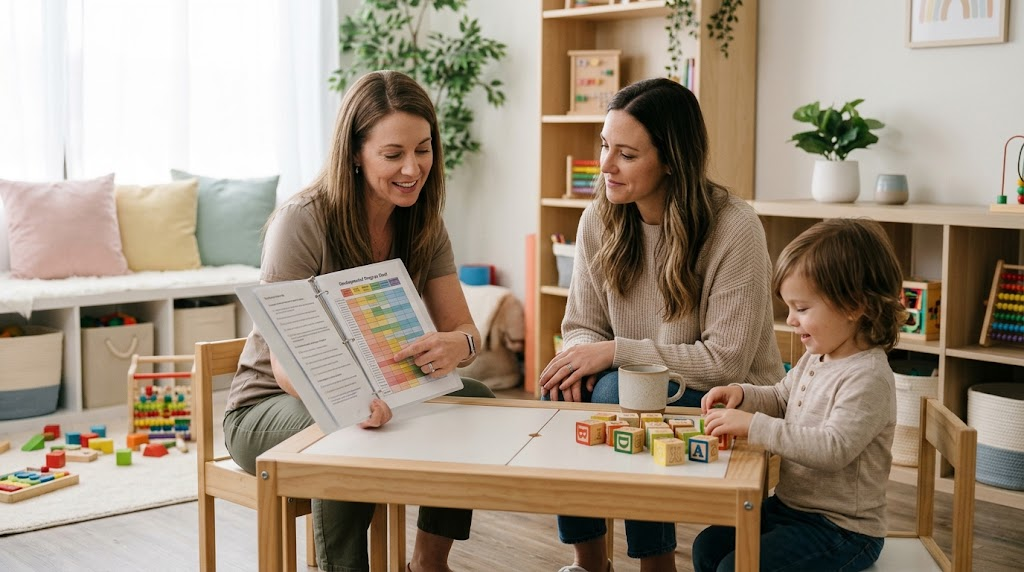
Most mothers ask us some version of this question before their child’s first session, usually while glancing at the calendar. How many months are we talking about? When will my child finish speech therapy? Is this a season, or a long-term commitment?
It’s a fair question when you’re weighing time, money, and a busy family schedule. We can’t give you a single number, because every child’s path is different. What we can give you is an honest look at what shapes the timeline, how progress gets measured, and how you’ll know when your child is ready to graduate.

The Honest Answer: It Depends on Your Child
So, how long does speech therapy take for kids? For some children, it’s a matter of months. For others, it’s a longer partnership. Both are completely okay.
The American Speech-Language-Hearing Association (ASHA) describes ending speech services as a decision tied to goals and real-life needs, not to a set number of sessions. The finish line is your child’s progress, not the calendar.
That’s why every plan should be individualized. A child working on one tricky sound and a child learning to put words together for the first time are on very different paths, even if they’re the same age.
What Shapes the Timeline
Several things tend to influence how many speech therapy sessions a child needs.
The type of challenge. Speech therapy covers a wide range of needs, including articulation (how sounds are made), language (understanding and using words), fluency (stuttering), and motor planning for speech. A single sound error is usually a shorter road than a more complex motor speech challenge like childhood apraxia of speech.
How often therapy happens. Intensity matters. For childhood apraxia of speech, ASHA notes that a child may start with therapy several times a week and then attend less often as their speech improves.
Practice at home. What happens between sessions counts. Kids build skills through repetition, and a few minutes of playful practice during daily routines can make a real difference.
Consistency. Missed sessions, long breaks, and big life changes can slow momentum. That’s real life, and a good plan adjusts.
The whole child. Communication doesn’t happen in isolation. Hearing, attention, sensory processing, and emotional regulation all affect how ready a child’s brain is to take in and use language. When a child’s nervous system is overwhelmed, learning new speech skills can feel much harder.
How Speech Progress Is Measured
Measuring speech progress shouldn’t be a mystery. With a clear plan, you should be able to see where your child started and where they’re headed.
Here’s what that usually looks like:
- A baseline from the evaluation. This shows your child’s starting point in sounds, words, understanding, and social communication.
- Clear, measurable goals. For example, saying a target sound correctly in short phrases, or using two-word combinations during play.
- Tracking along the way. Your therapist notes how your child is doing on each goal over time.
- Regular check-ins with you. You’ll hear what’s improving, what’s still hard, and whether the plan needs to change.
If you’re ever unsure how your child is doing, ask. You deserve to understand the plan and feel like a partner in it.
When Does Speech Therapy End?
According to ASHA, services may end when goals have been met, when a person’s communication needs are being met in daily life, or when the family decides to stop. Some differences may remain even after goals are reached, and that can still be a meaningful outcome.
In practice, many families notice progress in everyday moments first. Your child orders at a restaurant. A grandparent understands them on the phone. A friend at co-op asks them to play, and they answer back. Those moments matter as much as any test score.
Sometimes therapy also steps down gradually, moving from more frequent sessions to fewer before ending. That gives your child time to use their new skills with less support.

How We Approach Speech Therapy at Sense Able Brain
At Sense Able Brain, our speech and language therapy is part of a whole-child approach. We look at how your child’s nervous system, sensory processing, and regulation affect communication, alongside the speech and language skills themselves. Our goal is lasting progress, not just practice that stays in the therapy room.
For some children, we may also include tools like Sound Learning Therapy with the Safe & Sound Protocol, which is designed to support auditory processing and regulation. Every plan is individualized through our A.B.L.E. Program: Activate. Balance. Link. Engage.
Because we’re a private-pay practice, we have flexibility to tailor session frequency and therapy approaches to your child’s individual needs. We’ll talk openly with you about your child’s goals, the plan, and how we’ll track progress together.
Questions to Ask Your Child’s Speech Therapist
If you’re trying to plan ahead, these questions can help:
- What are my child’s specific goals right now?
- How often do you recommend sessions, and why?
- How will we measure progress?
- What can I practice at home this week?
- When will we review the plan together?
Your child’s therapist should welcome these questions. Asking them keeps you an active partner in your child’s progress.
If you’re still deciding whether your child needs support at all, our children’s therapy services page is a helpful place to start. And if you’re wondering whether OT may also help, read about our occupational therapy services.
Take the Next Step With Confidence
How long does speech therapy take for kids? The truest answer is that it takes as long as your child needs to reach goals that matter in real life, and a clear plan helps you see the way forward.
If you’re still asking, “How long does speech therapy take for kids like mine?”, we’d love to help you find out. Contact our team to schedule a free screening, or read what other families say about Sense Able Brain on Google. Every child deserves a bright future, and every family deserves a plan they understand.
Reviewed by Kim Hazelton, OTR/L
Kim Hazelton is a pediatric occupational therapist with over 31 years of experience, the founder of Sense Able Brain Pediatric Therapy, the developer of the A.B.L.E. approach to pediatric therapy, and the author of Neuro Roots and Calm Down, Child. Our expert clinicians use that whole-person neurodevelopmental approach to address the root cause of a child’s sensory, speech, feeding, and learning challenges, and to help them build a path forward to meet milestones and achieve lasting skills for success at home and in learning.