

Occupational therapy and speech therapy support different areas of a child’s development, but their work can overlap. If your child struggles with communication, sensory processing, feeding, coordination, or daily routines, it may be difficult to know which type of therapy to pursue or whether both would help.
Understanding what each therapist addresses can help you identify the right starting point and build a care plan around your child’s specific needs.

Source: Magnific
What Occupational Therapy Actually Does (Beyond “Life Skills”)
Occupational therapy for kids focuses on the underlying neurological and sensory systems that make daily tasks possible. An OT looks at how a child’s brain processes sensation, how their body moves in space, whether retained primitive reflexes are interfering with healthy development, and whether the nervous system is regulated enough to grow and learn.
In practice, occupational therapy covers sensory processing, emotional and behavioral regulation, reflex integration, fine and gross motor skills, handwriting, feeding, visual-motor integration, reading, coordination, and daily living activities like dressing and bathing. When a child melts down at the grocery store, can’t sit still for one worksheet, or refuses to touch anything with an unfamiliar texture, there’s often a sensory-motor root cause that OT is able to address directly.
What Speech Therapy Actually Does
Speech-language pathology covers far more than pronunciation. Speech and language therapy addresses how children develop and understand language, express themselves, connect sounds to meaning, process spoken information, process written information, and communicate in real-world interactions.
An SLP works on the following:
- language delays
- articulation
- Gestalt Language Processing (a natural language acquisition pattern often seen in children with autism)
- stuttering
- apraxia of speech (and dyspraxia of speech)
- AAC (augmentative and alternative communication for nonverbal or minimally verbal children)
- reading and phonological awareness
- social communication.
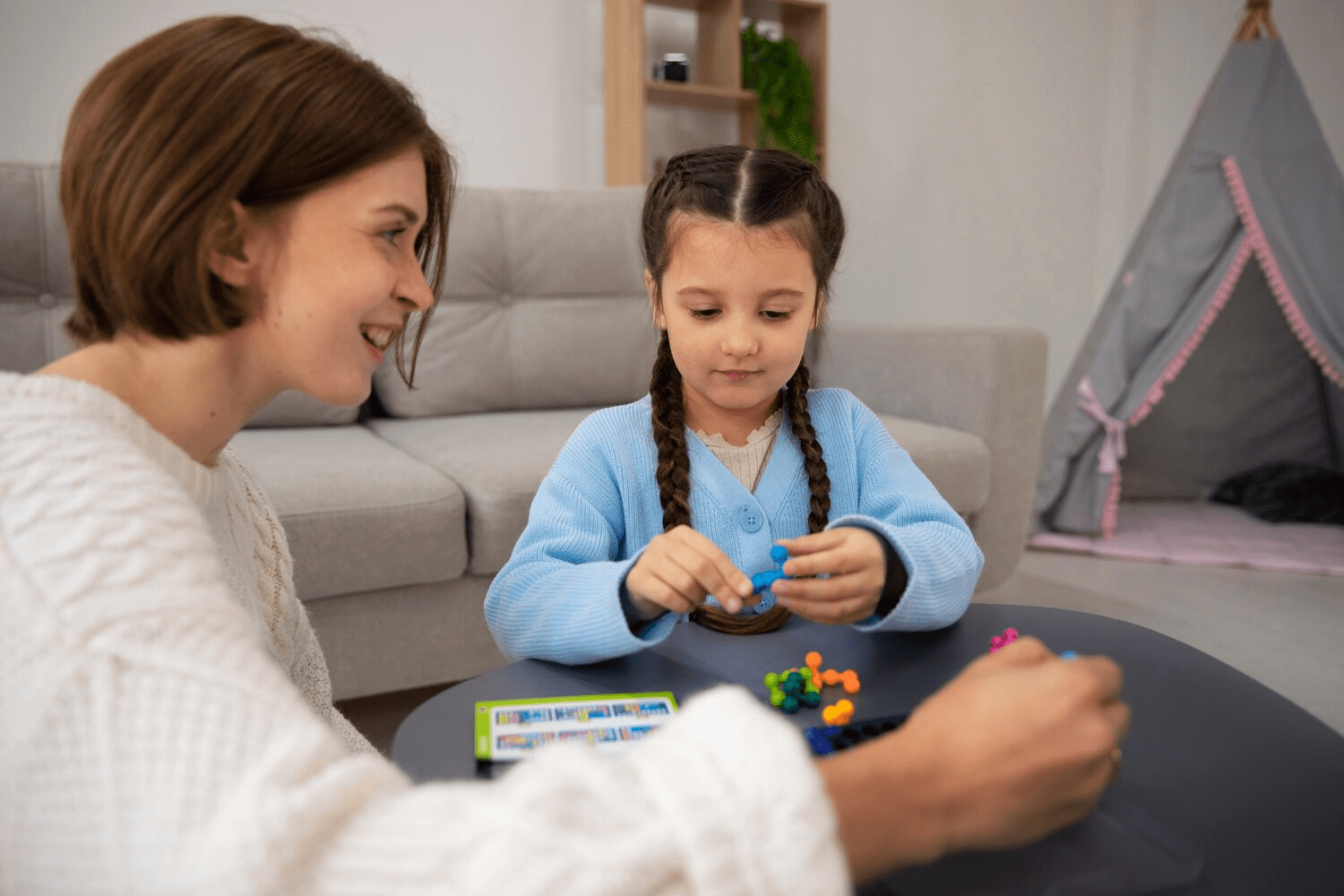
Feeding therapy sits at the intersection of both disciplines — both OTs and SLPs can work with children who have oral motor challenges, sensory-based food aversions, or conditions like ARFID.
Source: Magnific
Where OT and Speech Therapy Overlap
Occupational Therapy and Speech-Language Pathology go hand in hand, especially when supporting kids with autism, ADHD, sensory processing differences, or developmental delays. That’s because a child’s physical body and communication skills are deeply connected.
- Sensory Processing: Impacts the nervous system regulation and is a prerequisite for sustained auditory processing and language engagement.
- Motor Foundations: Oral-motor speech production frequently relies on foundational postural stability and facial muscle tone addressed through OT.
- Diagnostic Overlap: Sensory dysregulation can manifest as expressive delays, while receptive language difficulties are easily misidentified as behavioral non-compliance.
ASHA clinical guidance highlights that speech-motor disorders, such as Childhood Apraxia of Speech, regularly present alongside global motor delays and feeding difficulties. Addressing these interlinked systems simultaneously prevents therapy plateaus and leads to more durable developmental outcomes.
Does My Child Need Both?
Some children benefit from receiving both occupational and speech therapy. An assessment can help identify which challenges are affecting your child most, and our therapists can help guide you as to whether services should begin together or in stages. A child who has difficulty processing sensory input may need occupational therapy support to participate more consistently in speech sessions. Children with feeding or oral-motor challenges may also benefit from coordinated care between an OT and SLP.
At Sense Able Brain, OTs and SLPs collaborate by sharing observations and developing treatment plans based on each child’s needs. The A.B.L.E. program, which stands for Activate, Balance, Link, and Engage, adds neurodevelopmental support to help children apply the skills they practice in therapy to their everyday activities.
Signs Your Child May Need OT
Your child may benefit from occupational therapy if they:
- Avoid or seek out intense sensory experiences (refusing certain textures, craving crashing into things)
- Have meltdowns that seem out of proportion to the trigger
- Avoid getting dirty, having hair brushed, or wearing certain clothing
- Have poor balance, clumsy movements, or difficulty with sports
- Struggle to sit still, stay focused, or transition between activities
- Have feeding challenges with certain textures or temperatures
- Struggle with handwriting, scissors, or fine motor tasks
Signs Your Child May Need Speech Therapy
Your child may benefit from speech-language therapy if they:
- Have delayed speech or aren’t yet talking by expected ages
- Are hard to understand even by family members
- Struggle to follow multi-step directions
- Rely on echolalia (repeating phrases or scripts) as a primary way of communicating
- Avoid conversation or can’t sustain back-and-forth exchanges
- Struggle with reading, phonics, or connecting sounds to letters
- Stutter or have word-finding difficulties
- Need AAC support to communicate reliably
The National Institute on Deafness and Other Communication Disorders estimates that about 1 in 14 young children (roughly 7 percent) has had a disorder related to voice, speech, or language — many of them also carry unaddressed sensory or motor challenges that go untreated because no one connected the dots.
Source: Magnific
If You’re Still Unsure
A diagnosis isn’t a prerequisite to start. The most useful first step is a free phone consultation with one of our therapists so you can describe your child’s sensory, motor, and communication challenges without them present, and the therapist will help guide you toward your next best step. The services page outlines what’s offered, and the FAQ page answers the questions parents ask most often.
For families in the Lutz, Florida area ready to get started, call 813-803-3470. You may also read what other families say about their experience with Sense Able Brain on Google.