

Imagine your child’s brain like a transportation system. Many kids you see — the ones zipping through math facts, tying shoes effortlessly, or managing transitions without meltdowns — are driving on smooth, multi-lane highways. Their nervous system has built fast, efficient roads that connect the body and brain in ways that support learning, movement, and emotional regulation.
But for your child, things might look a little different. Maybe they’re bright, creative, and curious — but they struggle with sitting still, holding a pencil, or managing emotions that seem “too big” for the situation. You see their potential, but getting through daily tasks feels like driving a bumpy one-lane country road. They’ll get there… but it’s slower, harder, and not always predictable.
Those country roads? They’re often immature reflex pathways — primitive routes the brain built early in life that were only meant to be temporary. When those roads don’t get replaced by the smoother highways of mature brain development, your child ends up relying on outdated systems to do very modern things.
Let’s take a ride together and explore what’s going on under the surface.
What Are Primitive Reflexes?
Primitive reflexes are automatic responses — built-in programs that the body runs without needing conscious thought. They’re stimulated by sensory input: something your child hears, sees, feels, or how their body moves or balances. Almost all reflexes (except Fear Paralysis while in the womb) are triggered this way.
They’re essential at birth — helping babies survive in utero, move through the birth canal, latch, coordinate breath and swallowing, and begin to explore their world. But they’re not meant to last forever.
Each reflex has a lifespan:
- Pre-emergent (wired into the brainstem)
- Emerging (starting to show signs)
- Active (clearly present and functional)
- Integrating (beginning to fade)
- Integrated/dormant/inhibited (no longer interfering)
- Reactivated (coming back online under stress or trauma)
When integration happens as it should, the brain is free to build new neural “superhighways” — patterns that support posture, coordination, emotional resilience, attention, and learning. The old roads are still there in the background, but they’re no longer in use.
But when reflexes don’t integrate, or get stuck at one stage, the brain continues to use those one-lane roads — primitive patterns that were only designed for early development. And that can impact nearly everything.
How Immature Reflexes Affect Function
Reflexes don’t exist in isolation. They follow a kind of progression or pathway — each one supporting the next. A reflex that emerges may help another integrate, and one that’s integrating may prepare the way for the next to appear. If a reflex gets stuck, it can ripple both backward and forward — disrupting the timing and maturity of the reflexes before it and those after it. That’s why a single non-integrated reflex can affect multiple developmental skills.
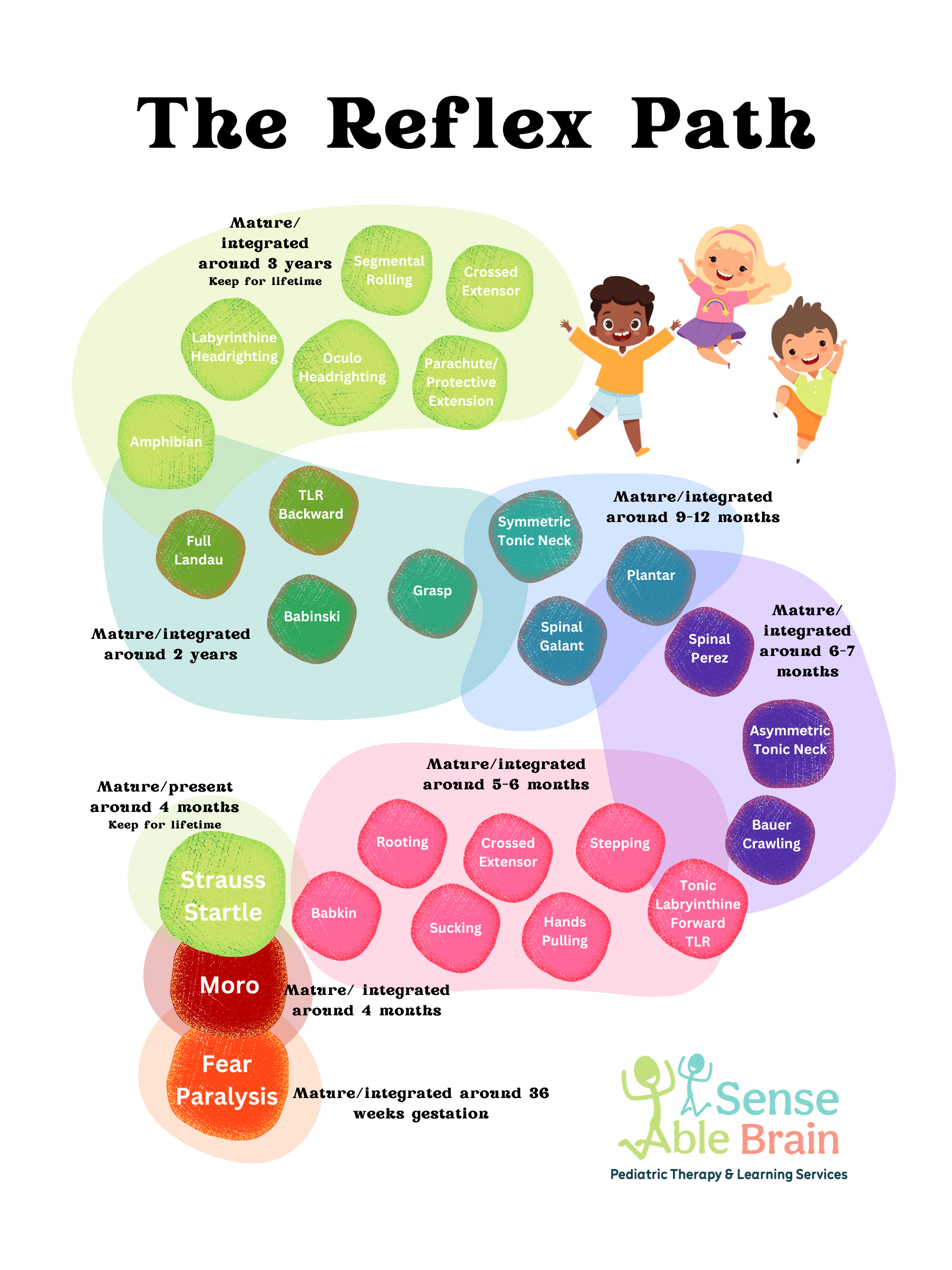
And here’s what this looks like in real life: the child’s maturation level varies across domains. A child may seem perfectly age-appropriate with self-care (dressing, brushing teeth), advanced in language (using big words or sophisticated sentences), but significantly behind in motor skills (tripping often, struggling to ride a bike). Emotional regulation can be especially sensitive, because reflexes are strongly tied to survival and stress responses.
This explains why your child can appear one age in one domain, another in a different skill, and another somewhere else entirely. And since emotional state is influenced by environment, a noisy or unpredictable setting can actually amplify reflex responses. The same child who’s calm and capable at home may fall apart in a crowded classroom — not because they’ve lost skills, but because the stress makes those immature pathways louder.


Why It Looks So Inconsistent
You might wonder: “But sometimes they CAN do it. Why not all the time?”
This is one of the most frustrating things for parents — and it’s also one of the biggest clues that reflexes may be playing a role. Immature reflex pathways leave children with uneven development. They may be functioning like an 11-year-old emotionally, a 5-year-old posturally, and a 7-year-old academically — all in the same day.

The result? Inconsistent performance. They look fine in one area and totally out of sync in another. They try hard, but fatigue quickly. They can pay attention — until they can’t. It’s not laziness or defiance. It’s a neurological mismatch.
But the good news? We can help build better roads.
3 Simple Ways to Begin Supporting Reflex Integration at Home
You don’t need fancy equipment or a therapy gym to start laying new tracks. Here are three things you can do right now that gently encourage the brain to shift from dirt road to expressway:
1. Lead with Regulation
When in doubt, regulate first.

Use strategies like breath control (blowing bubbles, guided breathing, pretending to blow up balloons), deep pressure/proprioceptive input (bear hugs, weighted blankets, pushing or pulling activities), slow rhythmic movement (rocking, swinging) to calm the system.
2. Incorporate Daily Movement
The brain wires through movement. Swinging, crawling, marching, and doing “heavy work” (like pushing laundry baskets or doing wall sits) all stimulate integration. Or use small movements like looking right and left, rolling the shoulders, or curl the toes for subtle improvements. Keep it fun, short, and consistent — even 5–10 minutes a day makes a difference.

3. Watch for Triggers and Patterns
Start noticing what seems to activate your child’s reflex responses. Is it bright lights? Transitions? Background noise? Emotional stress? Keep a simple log or just observe. You’ll start to see that the “meltdowns” or zoning out aren’t random — they’re neurological. And once you see the pattern, you can create support systems that reduce the load.
There’s a Reason It Feels Hard — But There’s Also a Way Through
If your child’s development feels patchy, unpredictable, or stuck, it’s not because you’re doing something wrong. And it’s not because your child is disobedient or “just not trying.”
You’re likely navigating an old road system that’s trying to handle modern-day traffic.
At Sense Able Brain, we’ve walked with thousands of families who were exactly where you are — confused, exhausted, and desperate for answers that actually make sense. When you understand what reflexes are and how they work, it becomes clear why your child struggles with the things they do — and how to support them with compassion, patience, and strategy.
You’re not alone on this road. And with the right tools and guidance, we can help your child build those smoother, stronger pathways that God designed them to grow into.
They were made with purpose — and their journey may be slower, but it’s no less beautiful.
~ Your SAB Team
Go here for 3 Easy Steps to Get Started With Us!
We are located in Lutz, Florida in Hillsborough county, in the greater Tampa Bay area. We serve families throughout the state of Florida through our in-office therapy sessions and our remote telehealth therapy sessions.